
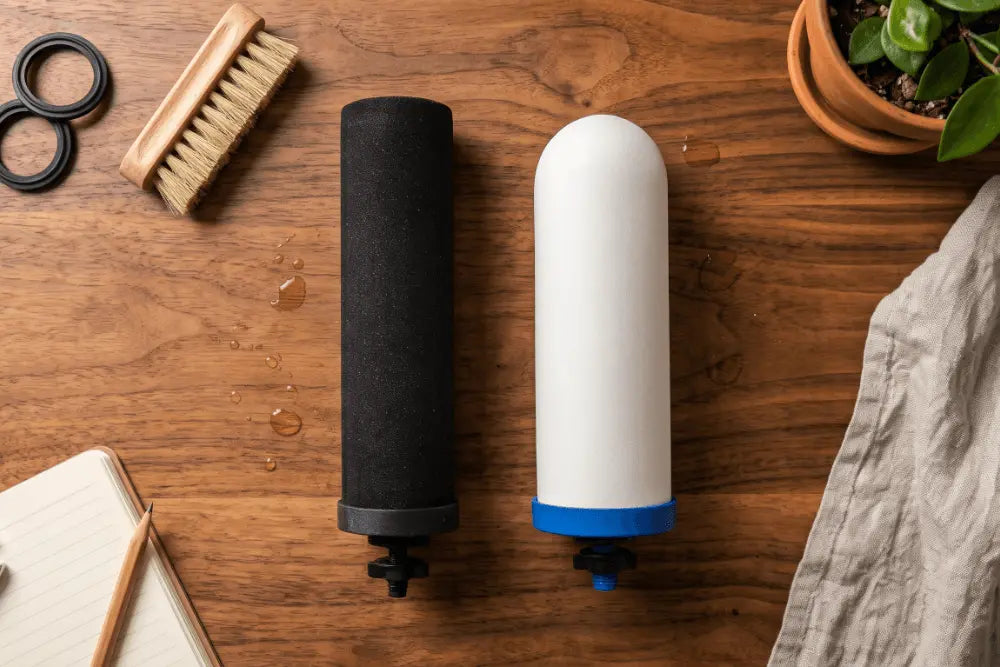
Two cartridges that look alike can treat water in completely different ways. In home filtration, the material used plays an important role, but it does not explain everything: a cartridge often combines several technologies. Here are the main families to know so that you understand what you are buying and avoid confusion.
Activated carbon: for taste, odour and certain organic compounds
Activated carbon has a porous structure that allows it to retain certain molecules present in water through adsorption. It is commonly used to improve taste and odour, particularly when these are linked to chlorine. Some filters can also reduce organic substances, but effectiveness depends on the carbon, the flow rate and the cartridge as a whole.
Ceramic: a physical barrier to particles
A porous ceramic cartridge retains particles and, depending on pore size and design, certain microorganisms. A plain ceramic should be distinguished from a composite element that combines ceramic and activated carbon, such as the Coldstream FTO+ cartridge. The stated nominal diameter is not enough to infer overall performance: what counts are the tested claims.
Membranes: from microfiltration to reverse osmosis
Microfiltration, ultrafiltration and nanofiltration are different families of membrane separation. They do not necessarily retain the same contaminants. Reverse osmosis uses a more selective membrane and can reduce many dissolved substances; on the other hand, it requires a suitable installation and maintenance, and usually produces waste water.
Ion exchange resins: a targeted function
Resins exchange certain ions present in water for others. They are used in particular for softening or in processes targeting specific dissolved substances. A cartridge of this type is not synonymous with microbiological filtration: its function depends on the choice of resin and on the system.
| Technology | Key points |
|---|---|
| Activated carbon | Taste, odour, certain organic compounds, depending on the product's tests. |
| Ceramic | Particles; microbiological capability depending on the pores and specific tests. |
| Membrane | Physical separation whose capabilities vary with fineness and technology. |
| Ion exchange resin | Targeted chemical exchange, for example to reduce certain ions. |
| Combined cartridge | Combines several principles; you need to read its full product sheet and the product's tests. |
Why “multi-stage filtration” does not tell the whole story
A commercial system may advertise three, five or even more stages. This number is not a universal indicator of quality. The stages may be relevant (pre-filtration, adsorption, membrane) or count several very similar operations. The key thing is still to check which substance is treated, the capacity of the cartridge and the nature of the evidence available.
Choosing the right replacement cartridge
- Identify the exact model of your system and the cartridge reference.
- Check mechanical compatibility and fitting requirements.
- Find out which substances a specific result exists for.
- Check the recommended volume or replacement interval.
- Make sure replacement cartridges are available.
The replacement elements and cartridges sold on Nice Water are grouped under Purification elements, each with its own product page. To choose a complete system, read our guide Which water filter should you choose?